 91eaff1341
* refine the plan

* Fix all staticcheck lint findings (uncapped)

golangci-lint's default max-same-issues=3 was hiding most of the backlog:
the true pre-fix count was 69 staticcheck findings, not 34. This fixes all
of them, driving staticcheck to zero:

- ST1023/QF1011 (37): omit explicit types inferred from the RHS
- S1009/S1031 (15): drop redundant nil checks before len()/range
- SA9003 (9): remove comment-only empty branches, keeping the comments
- QF1007 (3): merge conditional assignment into declaration
- QF1006 (3): lift break conditions into loop conditions
- QF1001 (3): apply De Morgan's law / name the negated predicate

Also updates plans/lintfixes.md with the cap discovery and the corrected
errcheck picture (1202 uncapped, ~949 of them fmt.Fprint*).

Co-Authored-By: Claude Fable 5 <noreply@anthropic.com>

* Drive errcheck to zero: config for bulk categories, propagate real errors

Adds .golangci.yml with errcheck exclude-functions for fmt.Fprint* (usage
printers), (*bufio.Writer).Write/WriteString (sticky errors, surfaced at the
now-checked final Flush), and (*strings.Builder).WriteString; pins
max-issues-per-linter/max-same-issues to 0 so CI reports true counts.

Real error paths now propagate instead of being dropped:
- Finalize{Reader,Writer}Options in join/put/filter/split/tee and the
  repl/script entry points: 'mlr join -i badformat' now errors instead of
  silently using wrong separators
- final output-stream Flush in pkg/stream: write failure no longer exits 0
- DSL emit/print/dump redirect writes, matching their sibling branches
- CSV writer WriteCSVRecordMaybeColorized, close-time Flush in file output
  handlers, ENV[...] Setenv, REPL record-write and redirect-close errors
- termcvt write-side Close before rename (had "TODO: check return status")

The rest are deliberate ignores, marked with _ = and a comment where the
reason isn't obvious: unset-of-missing-path no-ops, read-side closes,
mid-stream FlushOnEveryRecord, init-time strftime registrations, in-memory
usage-capture pipes, and regtest-harness env/temp-file teardown.

golangci-lint now reports 0 issues on ./cmd/mlr ./pkg/... with all caps off.

Co-Authored-By: Claude Fable 5 <noreply@anthropic.com>

---------

Co-authored-by: Claude Fable 5 <noreply@anthropic.com>
|
||
|---|---|---|
| .github | ||
| cmd | ||
| data | ||
| docs | ||
| man | ||
| pkg | ||
| plans | ||
| python | ||
| scripts | ||
| snap | ||
| test | ||
| tools | ||
| vim | ||
| .all-contributorsrc | ||
| .codespellignore | ||
| .gitattributes | ||
| .gitignore | ||
| .golangci.yml | ||
| .goreleaser.yml | ||
| .readthedocs.yaml | ||
| .vimrc | ||
| CLAUDE.md | ||
| configure | ||
| create-release-tarball | ||
| delve.txt | ||
| go.mod | ||
| go.sum | ||
| LICENSE.txt | ||
| Makefile | ||
| miller.spec | ||
| README-dev.md | ||
| README-docs.md | ||
| README-go-port.md | ||
| README-profiling.md | ||
| README-RPM.md | ||
| README-versions.md | ||
| README.md | ||
| regression_test.go | ||
| todo.txt | ||
What is Miller?
Miller is like awk, sed, cut, join, and sort for data formats such as CSV, TSV, JSON, JSON Lines, and positionally-indexed.
What can Miller do for me?
With Miller, you get to use named fields without needing to count positional indices, using familiar formats such as CSV, TSV, JSON, JSON Lines, and positionally-indexed. Then, on the fly, you can add new fields which are functions of existing fields, drop fields, sort, aggregate statistically, pretty-print, and more.
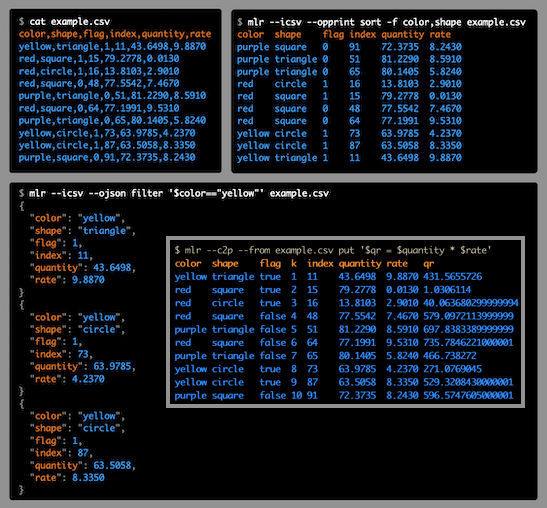
-
Miller operates on key-value-pair data while the familiar Unix tools operate on integer-indexed fields: if the natural data structure for the latter is the array, then Miller's natural data structure is the insertion-ordered hash map.
-
Miller handles a variety of data formats, including but not limited to the familiar CSV, TSV, and JSON/JSON Lines. (Miller can handle positionally-indexed data too!)
In the above image you can see how Miller embraces the common themes of key-value-pair data in a variety of data formats.
Getting started

- Miller in 10 minutes
- A Guide To Command-Line Data Manipulation
- A quick tutorial on Miller
- Miller Exercises
- Tools to manipulate CSV files from the Command Line
- www.togaware.com/linux/survivor/CSV_Files.html
- MLR for CSV manipulation
- Linux Magazine: Process structured text files with Miller
- Miller: Command Line CSV File Processing
- Miller - A Swiss Army Chainsaw for CSV Data, Data Science and Data Munging
- Pandas Killer: mlr, the Scientist
More documentation links
- Full documentation
- Miller's license is two-clause BSD
- Notes about issue-labeling in the Github repo
- Active issues
Installing
There's a good chance you can get Miller pre-built for your system:














| OS | Installation command |
|---|---|
| Linux | yum install millerapt-get install millersnap install miller |
| Mac | brew install millerport install miller |
| Windows | choco install millerwinget install Miller.Millerscoop install main/miller |
See also README-versions.md for a full list of package versions. Note that long-term-support (LtS) releases will likely be on older versions.
See also building from source.
Community



- Discussion forum: https://github.com/johnkerl/miller/discussions
- Feature requests / bug reports: https://github.com/johnkerl/miller/issues
- How to contribute: https://miller.readthedocs.io/en/latest/contributing/
Build status




Building from source
- First:
cd /where/you/want/to/put/the/sourcegit clone https://github.com/johnkerl/millercd miller
- With
make:- To build:
make. This takes just a few seconds and produces the Miller executable, which is./mlr(or.\mlr.exeon Windows). - To run tests:
make check. - To install:
make install. This installs the executable/usr/local/bin/mlrand manual page/usr/local/share/man/man1/mlr.1(so you can doman mlr). - You can do
./configure --prefix=/some/install/pathbeforemake installif you want to install somewhere other than/usr/local.
- To build:
- Without
make:- To build:
go build github.com/johnkerl/miller/v6/cmd/mlr. - To run tests:
go test github.com/johnkerl/miller/v6/pkg/...andmlr regtest. - To install:
go install github.com/johnkerl/miller/v6/cmd/mlr@latestwill install to GOPATH/bin/mlr.
- To build:
- See also the doc page on building from source.
- For more developer information please see README-dev.md.
For developers
License
Features
-
Miller is multi-purpose: it's useful for data cleaning, data reduction, statistical reporting, devops, system administration, log-file processing, format conversion, and database-query post-processing.
-
You can use Miller to snarf and munge log-file data, including selecting out relevant substreams, then produce CSV format and load that into all-in-memory/data-frame utilities for further statistical and/or graphical processing.
-
Miller complements data-analysis tools such as R, pandas, etc.: you can use Miller to clean and prepare your data. While you can do basic statistics entirely in Miller, its streaming-data feature and single-pass algorithms enable you to reduce very large data sets.
-
Miller complements SQL databases: you can slice, dice, and reformat data on the client side on its way into or out of a database. You can also reap some of the benefits of databases for quick, setup-free one-off tasks when you just need to query some data in disk files in a hurry.
-
Miller also goes beyond the classic Unix tools by stepping fully into our modern, no-SQL world: its essential record-heterogeneity property allows Miller to operate on data where records with different schema (field names) are interleaved.
-
Miller is streaming: most operations need only a single record in memory at a time, rather than ingesting all input before producing any output. For those operations which require deeper retention (
sort,tac,stats1), Miller retains only as much data as needed. This means that whenever functionally possible, you can operate on files which are larger than your system’s available RAM, and you can use Miller in tail -f contexts. -
Miller is pipe-friendly and interoperates with the Unix toolkit.
-
Miller's I/O formats include tabular pretty-printing, positionally indexed (Unix-toolkit style), CSV, TSV, JSON, JSON Lines, and others.
-
Miller does conversion between formats.
-
Miller's processing is format-aware: e.g. CSV
sortandtackeep header lines first. -
Miller has high-throughput performance on par with the Unix toolkit.
-
Miller is written in portable, modern Go, with zero runtime dependencies. You can download or compile a single binary,
scpit to a faraway machine, and expect it to work.
What people are saying about Miller
Today I discovered Miller—it's like jq but for CSV: https://t.co/pn5Ni241KM
— Adrien Trouillaud (@adrienjt) September 24, 2020
Also, "Miller complements data-analysis tools such as R, pandas, etc.: you can use Miller to clean and prepare your data." @GreatBlueC @nfmcclure
Underappreciated swiss-army command-line chainsaw.
— Dirk Eddelbuettel (@eddelbuettel) February 28, 2017
"Miller is like awk, sed, cut, join, and sort for [...] CSV, TSV, and [...] JSON." https://t.co/TrQqSUK3KK
Miller looks like a great command line tool for working with CSV data. Sed, awk, cut, join all rolled into one: http://t.co/9BBb6VCZ6Y
— Mike Loukides (@mikeloukides) August 16, 2015
Miller is like sed, awk, cut, join, and sort for name-indexed data such as CSV: http://t.co/1zPbfg6B2W - handy tool!
— Ilya Grigorik (@igrigorik) August 22, 2015
Btw, I think Miller is the best CLI tool to deal with CSV. I used to use this when I need to preprocess too big CSVs to load into R (now we have vroom, so such cases might be rare, though...)https://t.co/kUjrSSGJoT
— Hiroaki Yutani (@yutannihilat_en) April 21, 2020
Miller: a *format-aware* data munging tool By @__jo_ker__ to overcome limitations with *line-aware* workshorses like awk, sed et al https://t.co/LCyPkhYvt9
— Donny Daniel (@dnnydnl) September 9, 2018
The project website is a fantastic example of good software documentation!!
Holy holly data swiss army knife batman! How did no one suggest Miller https://t.co/JGQpmRAZLv for solving database cleaning / ETL issues to me before
— James Miller (@japanlawprof) June 12, 2018
Congrats to @__jo_ker__ for amazingly intuitive tool for critical data management tasks!#DataScienceandLaw #ComputationalLaw
🤯@__jo_ker__'s Miller easily reads, transforms, + writes all sorts of tabular data. It's standalone, fast, and built for streaming data (operating on one line at a time, so you can work on files larger than memory).
— Benjamin Wolfe (he/him) (@BenjaminWolfe) September 9, 2021
And the docs are dream. I've been reading them all morning! https://t.co/Be2pGPZK6t
Contributors ✨
Thanks to all the fine people who help make Miller better (emoji key):


This project follows the all-contributors specification. Contributions of any kind are welcome!